Borax 1915-1928
While Death Valley Junction exists because of borax mining, the time during it was central to the operations of the Pacific Coast Borax Company are a relatively short piece of its history.
While Death Valley Junction exists because of borax mining, the time during it was central to the operations of the Pacific Coast Borax Company are a relatively short piece of its history.
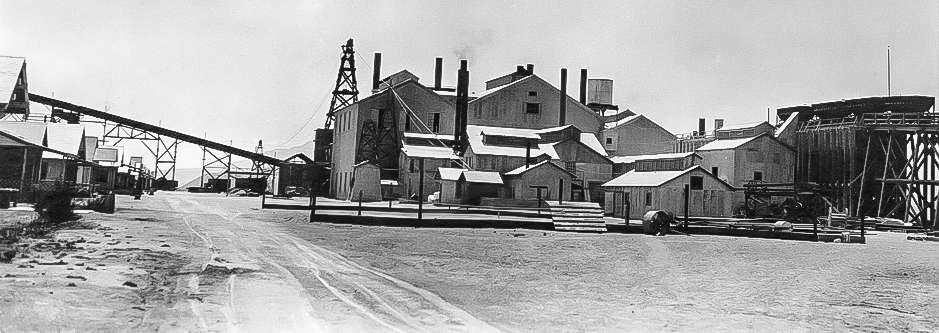
The Borax company didn't skimp when they were building their new mill at DVJ on the east side of the tracks in the station grounds. The previous mill at Ryan had two roasters and the new one had four, later expanded to six. A ramp and high trestle allowed the ore trains which came down each day from the mines to dump their load into the bins where it went into the crusher. The mill was powered by diesel generators fueled by oil that was stored in large tanks. A conveyor carried the waste that had been separated from the borax to a tailings pile that still exists today. A well was drilled on the site to provide water for the mill.
Because of the differing gauges of the T&TRR and DVRR, some tracks had three rails to accommodate trains from either railroad and others were one gauge or the other. A "roundhouse" for maintenence of the DVRR locomotives was built on the west side of the T&T main line.
Houses for the employees were moved from Ryan and some new ones were built in a row east of the mill. The superintendent's house was a relatively large Craftsman style home. There was no domestic water or electricity to begin with and every house had a privy behind it, but there were fire hydrants along the row of houses. This 1919 map shows the houses and buildings in the mill, but not any of the buildings on the west side of town.
Tubb's saloon and other businesses continued to operate west of the tracks, much to the annoyance of the uptight borax company management. In the 1920 census he is living with his two older sons and is listed as running a general retail store. His sister and her three children were living with them and she is listed as a cook in a restaurant.
In addition to Tubb's boys, there were a number of other children living in DVJ. In the fall of 1915, Tubb requested a public school teacher. Bess Davis, a 23 year old recent Normal School graduate arrived. At the time there wasn't a school in DVJ. The first year, Davis lived in a tent behind the superintendent's house and taught in a 9x12 shack with no blackboard. Davis taught there for two years before returning to Los Angeles. Eventually a school building was constructed at the north end of town.
Frank Grace was hired as a clerk for the borax company in 1916. He and Bess hit it off and eventually married years after both of them had left DVJ. Frank drew a map of the town that shows the mill, many of the houses and who lived in them, Bess Davis' "air castle" tent, Tubb's saloon, and a "tin shack" that housed the brothel run by another woman named Bessie.
In 1916 Bob Tubb sold a 50x150 foot lot to a person named Bessie Pain for $50. The description of the lot seems to be in the vicinity of the current cafe, and Ms. Pain is no doubt the Bessie who ran the brothel in the tin shack that was described earlier. Tubb also sold an acre of land on the east side of the tracks to John Rogers who operated a hotel that was constructed of railroad ties. He sold another 50x150 foot lot on the east side to someone named Wallace N. Routsong. It's not clear what Routsong did, but he was probably not an employee of the borax company. Grace's map shows a house occupied by "Wally & Roy" in that location.
Later in 1916 Tubb sold a half interest in his entire property to a woman named Abbie Pierce for $1500. Pierce was a widow from Arizona who Tubb had met when he lived there prior to coming to DVJ. Pierce and her four children lived there for a while before she got married again and moved away in 1918.
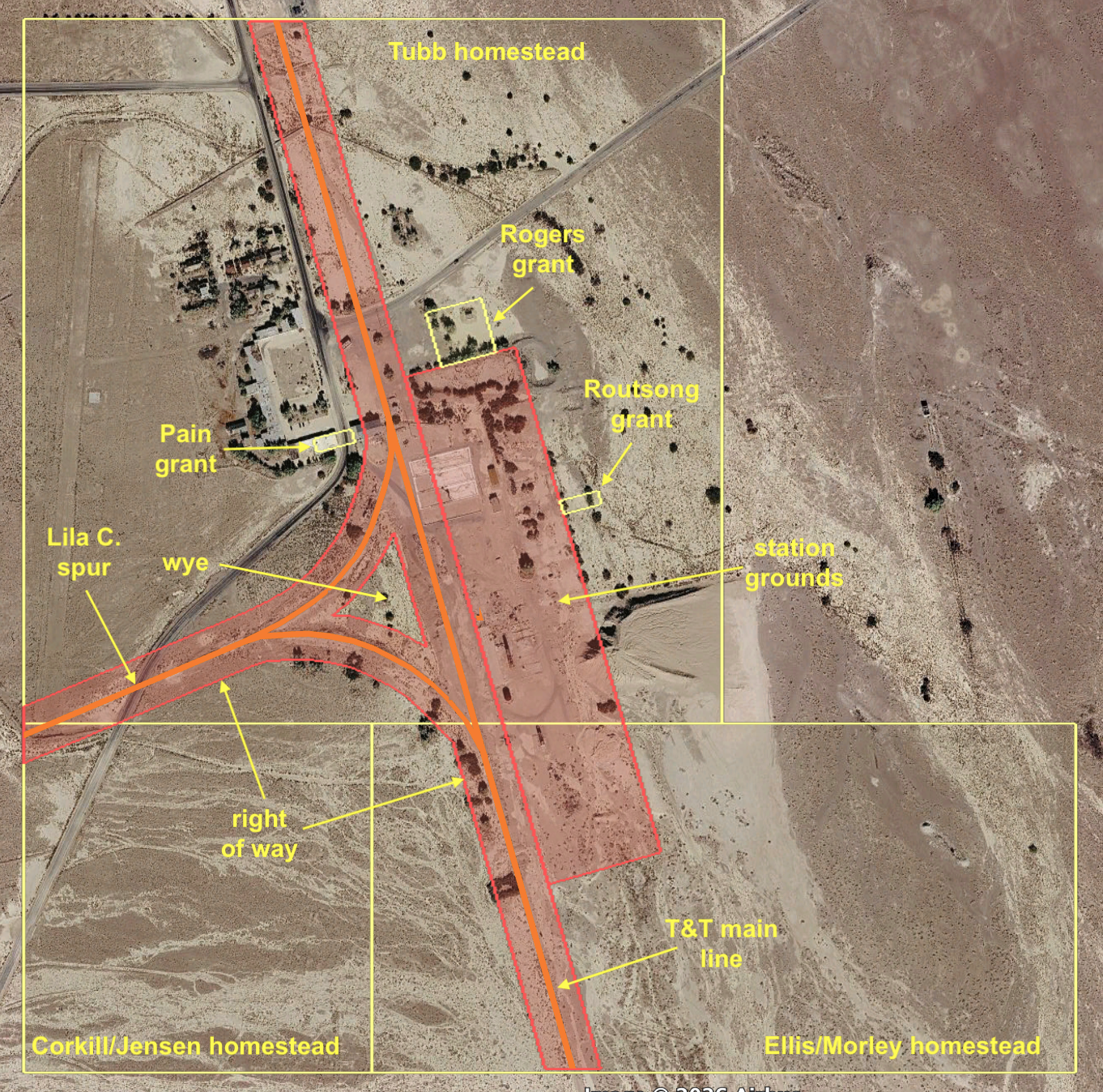
Two plots of land were acquired adjacent to and south of Tubb's land by the borax company. An 80 acre plot was granted to "George Carrington Ellis, Assignee, involving the right of John Morley" in 1914. This was done by purchasing land scrip. Under the 1862 Homestead Act the federal government had granted land to civil war veterans in the form of scrip that entitled the holder to claim ownership of up to 160 acres of public land in a location of their choice without the 5 year residency requirement. There was a market for this scrip, so instead of claiming the land the holder could sell his scrip to someone else who could then claim land or resell the scrip. Ellis, who was on the board of directors of Pacific Coast Borax, was the individual named to receive the 80 acres that John Morley, presumably a Union soldier or sailor, had been granted. He then deeded it to the company. The Ellis/Morley property contained the south third of the station grounds. Later, in 1919, a 40 acre plot was acquired the same way by "Frederick T. Corkill, assignee of Andrew Jensen".
In 1917, the borax company purchased property east of the tracks from Tubb and Abbie Pierce, minus the lots that had been sold to Rogers and Routsong, for $500. They now owned the property that they had built the mill on, having realized that previously the station grounds were supposed to be used for activities related to the railroad.
Even though they didn't need the land on the west side of the tracks for business purposes, the borax company wanted to get rid of Tubb and the other people there who they considered to be "undesirable neighbors". They had negotiated a deal in 1917 with Tubb to buy the rest of his land for $3500 but Tubb changed his mind and said that he wanted $4500, so the deal fell through. In 1919 The Routsong lot was purchased by the borax company for $50. At that time they were negotiating with Rogers to buy his property.
Eventually in 1923 the borax company was motivated to accept Tubb's terms and he sold his property to the borax company. The price had increased to $5500 for the land, buildings, and contents. They were also able to buy the Rogers and Pain properties, which finally gave them ownership of the entire 280 acres comprised of the three homesteads.
In the 1920 census the population was 148. Most were workers in the mill or on the railroad. There had been an article written in the magazine Harper's Weekly that year by the author Zane Gray in which he described a visit he made to DVJ.
... I visited the borax-mill. It was the property of an English firm, and the work of hauling, grinding, roasting borax ore went on day and night. Inside it was as dusty and full of a powdery atmosphere as an old-fashioned flour-mill. The ore was hauled by train from some twenty miles nearer the valley, and was dumped from a high trestle into chutes that fed the grinders. For an hour I watched this constant stream of borax as it slid down into the hungry crushers, and I listened to the chalk-faced operator who yelled in my ear. ... He said the mill was getting out twenty-five hundred sacks a day. The men, he said, did not last long at such labor, and in the mines six months appeared to be the limit of human endurance. How quickly I had enough of that choking air in the room where the borax was ground! And I found intolerable the place where the borax was roasted in huge, round, revolving furnaces. When I got out into the cool, clean desert air I felt an immeasurable relief, and that relief made me thoughtful of the condition of men who labored, who were chained by necessity, duty, habit, or by love, to the hard tasks of the world. It did not seem fair. These laborers of the borax mines and mills, like the stokers of ships, and coal-diggers, and blast-furnace hands--like thousands of men-killed themselves outright or impaired their strength, and when they were gone or rendered useless others were found to take their places.
This apparently embarrassed the borax company and was, at least in part, their motivation to improve the living and working conditions.
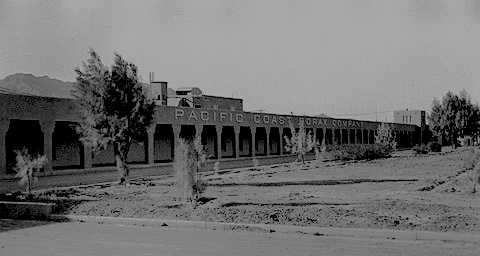
In 1923 construction started on a new building complex on the west side of the tracks, north of the wye. It was designed by renowned architect Alexander McCulloch. Built of adobe bricks on concrete foundations, it featured buildings arranged around a central square containing company offices, a post office, company store, dormitories for the workers, a dining hall, a hospital, and an auditorium. The dormitory rooms had electricity and common bathrooms with hot and cold running water. It also had steam heat for the winter and evaporative cooling for the summer. Behind it were a two story house for the superintendent and seven smaller cottages. $300,000 was spent on the construction. It was completed in 1924.
Electricity was provided by diesel generators in the mill. A new well was dug north of the mill to provide additional water for the town, both for domestic use and to supply strategically placed fire hydrants. A sewer line ran from the town a half mile east to a processing plant.
The auditorium, which was intended for meetings, dances, and movie screenings, was dedicated as Corkill Hall. Some of the dormitory rooms had private baths and were reserved for important visiting guests of potential investors.
In 1926, Clarence Rasor discovered large borax deposits in the Kramer district of southern Kern county. Because of the drastically reduced transportation costs, it was decided to shut down the mining and milling operations in Ryan and Death Valley Junction, even though the mines were still productive.


