The Dark Ages 1943-1967
What went on in Death Valley Junction in the period from the 1940s through the 1960s isn't as well known as other times. This is comparable to the "dark ages" in the history of this town.
World War II
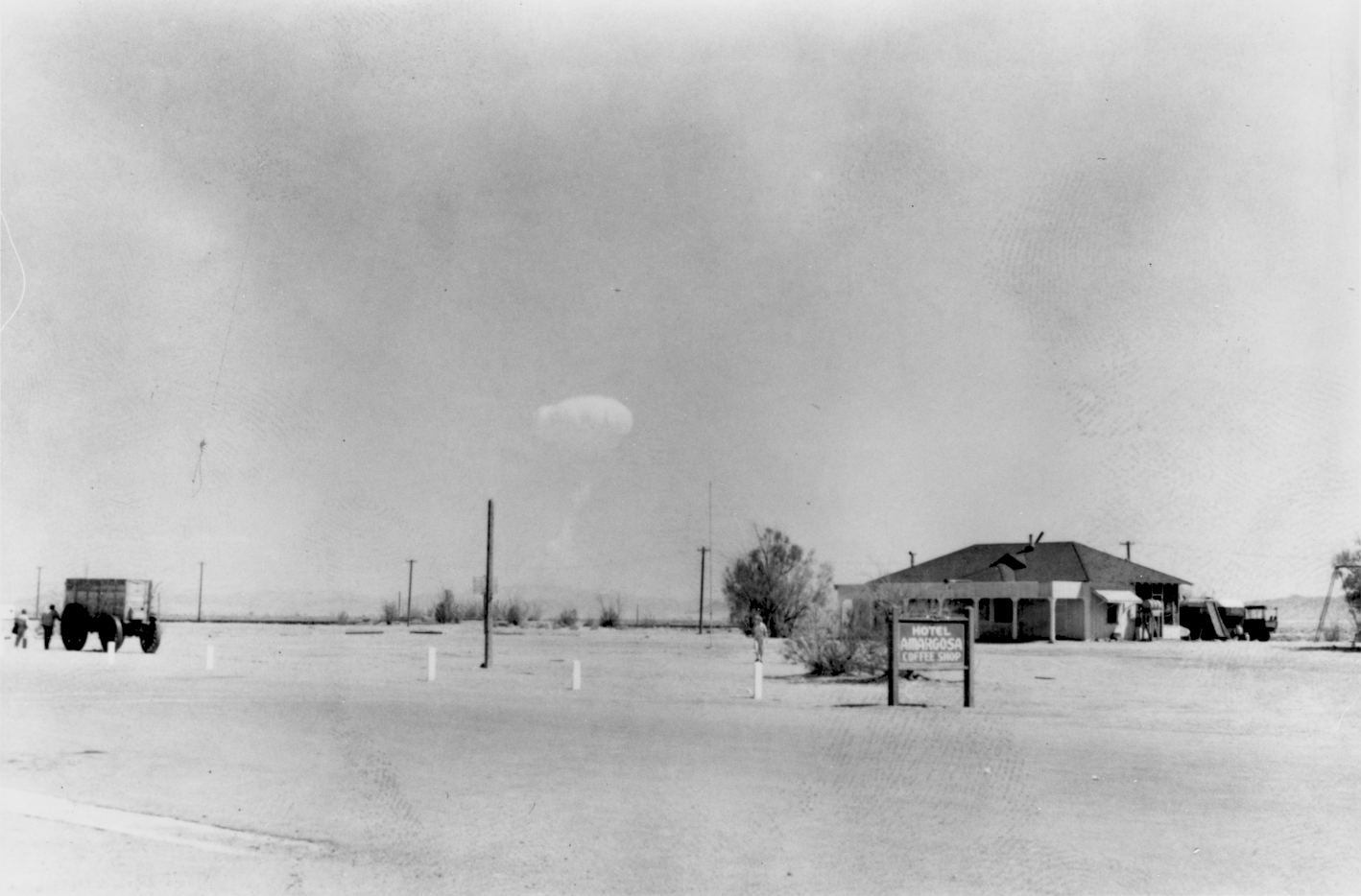
The railroad had ceased operations in 1940 and clay processing had shut down. At the beginning of World War II in 1942 the Furnace Creek Inn closed down. The Amargosa Hotel and restaurant were closed and only the cafe was open. The T&T rails were requisitioned for the war effort and beginning in 1942 the tracks were torn up, beginning at Beatty in the north, and moving south. This was completed in 1943 and the tracks were shipped to Egypt and used to construct a railroad there.
Many people who had been employed at the hotel and railroad moved away, including the Gowers, the Chisholms, and the Lowders. The school remained open for a while, but in 1943 it closed due to a lack of students. The town, however, was far from deserted. Newspaper articles during the war routinely described the activities of verious residents.
There was some clay and borax mining in the area and the DVJ mill was occasionally used for processing it.
During the war, the DVJ airport was used for flight training. The trainees and instructors lived in the hotel. They may have trained in Piper L-4 "Grasshopper" which was the military variant of the Piper J-3 "Cub" and was used for observation and artillery spotting.
Postwar
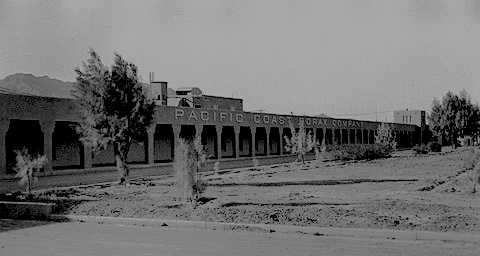
When the war ended in 1945, the Furnace Creek Inn was reopened under the management of Charles Scholl who also managed the Amargosa Hotel. Harry Gower wrote a report for the borax company in March 1946 that describes the state of the town in considerable detail. The mill was being used occasionally to process some clay or borax, but mainly it provided power to the town from its diesel generators. The adjacent houses of the old town were rented. The hotel, cafe, general store, hospital, laundry, and adjoining buildings were all in use. The steam plant provided heat and some of the hotel rooms had individual air conditioners.
The school reopened in the building that had been the train depot, with students coming from Furnace Creek, Pahrump, Shoshone, and Tecopa. The first graduating class in 1946 included Harry Rosenberg. The graduation ceremony was held in Corkill Hall.
In 1947 the mill was dismantled. The hotel had been dependent on it for power and water, so a generator was installed in the shop adjacent to the garage to provide electricity. The two water towers were left in place and water was periodically pumped from the well into one of them for use by the hotel.
During the 1950s the hospital was important to the area. May Dorville was the nurse in charge. In 1951 a portable x-ray machine was installed.
Out of the hotel business
The Amargosa Hotel continued operations through the 1950s. While the Death Valley Hotel Company had envisioned it and the Furnace Creek Inn as high end resorts, only the latter lived up this goal. The Amargosa was more of a transient hotel, serving passing travelers. The hotel, cafe, and gas station closed during the hot summer months. Laundry for both hotels was handled at DVJ.
In 1956 Pacific Coast Borax Company merged with United States Potash Corporation to form U.S. Borax. Since running hotels was not part of the core business of a mining company, U.S. Borax was undoubtedly eager to pass it on to someone else. In August 1956, the operations of the Amargosa Hotel and Furnace Creek were leased to the Fred Harvey Company which was in the resort hotel business. It took Fred Harvey 3 years to decide that the Amargosa Hotel was not a viable business and they decided to sell the property. No doubt the problems with the sewer system that would plague later owners were beginning to manifest themselves, and there was the continual threat of floods.
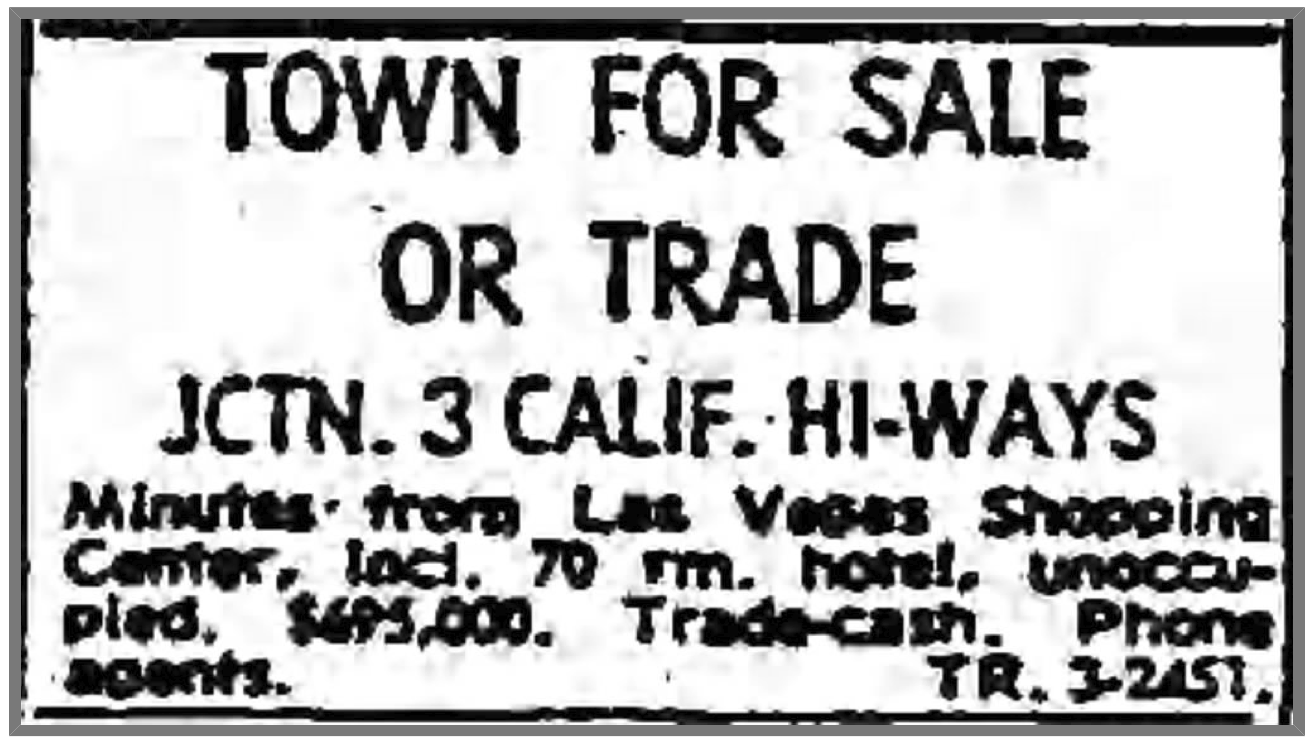
In 1959 the entire 275 acre property was sold to a Los Angeles real estate speculator named Wesley Casey for $40,000. Casey closed the hotel and let all the leases expire so businesses in the town were virtually shut down in 1960. There may have been residents living there in the houses but the population can't be confirmed until the 1960 census is made public in 2032. He did not make any improvements, and he immediately put it on the market for an asking price that started at $550,000 and was soon reduced to $495,000. He advertised it as a 70 room hotel "minutes from Las Vegas", which is technically true if you count all the habitable rooms in all the buildings including the hospital and round up.
The Mormons
Ettie Lee was a retired English teacher in Los Angeles who was concerned for boys who came from troubled homes. She had begun buying and selling real estate in 1927 and by 1960 she had eight homes where "wayward boys" could live. She was interested in starting a retirement community and therefore was interested in the property that Wesley Casey was selling. In December 1960 she purchased Death Valley Junction in exchange for a downtown Los Angeles building worth $80,000 and a $112,000 note.
While Lee had visited the town prior to purchasing it, she obviously had not done her due diligence and soon discovered that she hadn't gotten what she thought she had paid for. She had apparently been led to believe that all the rooms in the hotel had private baths when in reality only half of them did. The generator was unreliable, the water supply was inadequate, and the sewer system was breaking down. Lee refused to make payments on the note and Casey filed a Notice of Default in July 1961. Lee, in turn, filed a lawsuit against Casey for $460,000. This was eventually settled in January 1964 when a judge ruled that the property had been misrepresented and that Lee only owed $7,000.
Ettie Lee was a member of the Mormon Church which is known for having strong community ties. She enticed three fellow Mormon families to come live in Death Valley Junction. They were the Martinsens, the Taylors, and the Smiths. Over the next few years other residents were added - Tom and Mazie Bridges, Raymond Carr and his sister Altayna "Al" Bell, Dewey and Pearl Butler, and Judy Tubb who the granddaughter of the original town owner Bob Tubb.
The post office was moved in 1961 from DVJ to Furnace Creek and designated as "Death Valley". Later, in 1962, the post office was reopened in DVJ with the designation "Amargosa" and renamed back to "Death Valley Junction" in 1968. When Ettie Lee visited DVJ she sometimes hitched a ride on the mail truck.
The author J. David Lowell visited DVJ in 1963. In his book Intrepid Explorer: The Autobiography of the World's Best Mine Finder he writes
I stayed in Death Valley Junction Motel. Much of the population of Death Valley at that time was made up of the flotsam and jetsam of the U.S. population, and an act of violence occurred while I was there.
The cook in the motel was a retired Marine Corps cook and very tough and hard-bitten, and his wife, who was the postmistress, fit the same description. A triangle formed consisting of the cook and the postmistress, who were married, and the vice czar of the area, who had a house of ill repute not very far from Death Valley Junction. The cook caught the postmistress and vice czar in a compromising situation and shot them both with a pistol. The vice czar then wrestled the pistol away from the cook and shot him. Somebody called the nearest hospital, in Lone Pine, California, which sent its lone ambulance to the site of the violence; all three participants of the triangle had to ride together to Lone Pine.
This incident happened in Ash Meadows according to this newspaper article. It's likely that the cook he describes was Raymond Carr who was a Marine who had served in WWII and Korea who lived in DVJ with his wife Helen. The "vice czar" was a man named Lyle Gross who operated the Ash Meadows Lodge, a legal brothel in Nevada. Helen probably left after the shooting and she and Ray were eventually divorced in 1967. Carr's sister Al Bell took over the job as postmistress. Ray continued to live in DVJ until 1973 when he died and was buried in the cemetery. Later that year Gross was seriously injured when the trailer he was living in exploded according to another article.
In 1962 Pearl Butler and her husband Dewey moved to DVJ where he was the maintenance man and ran the gas station until 1966. At first they lived in the south dormitory and later moved into one of the houses. Pearl worked as a waitress in the Lila C. Cafe. One morning in 1963 when they were both at work, a fire broke out in their house which was significantly damaged so they had to move to a different house. The house didn't completely burn down, but it was never repaired. Pearl remembers frequently helping Dewey to fill the water tower and clean out clogged sewer lines.
Another job that Dewey had was to maintain the generator in the garage that supplied power to the town. In 1963, under the Rural Electrification Act, Death Valley Junction was finally attached to the electric power grid. Workers on the project had been staying in DVJ and in late 1962 there was another violent incident where one worker shot another in the face with a shotgun, seriously injuring him.
Next: Revival 1968-2005