Early days 1907-1914
Bob and Kittie Tubb
Robert Tubb was a 34 year old teamster from Texas who married a 16 year old mail order bride from Pennsylvania, Kathryn (Kittie) Marbaker in 1904. They were living in Arizona for the birth of their first two children, and had followed the construction crew of the T&T Railroad to what would become Death Valley Junction.
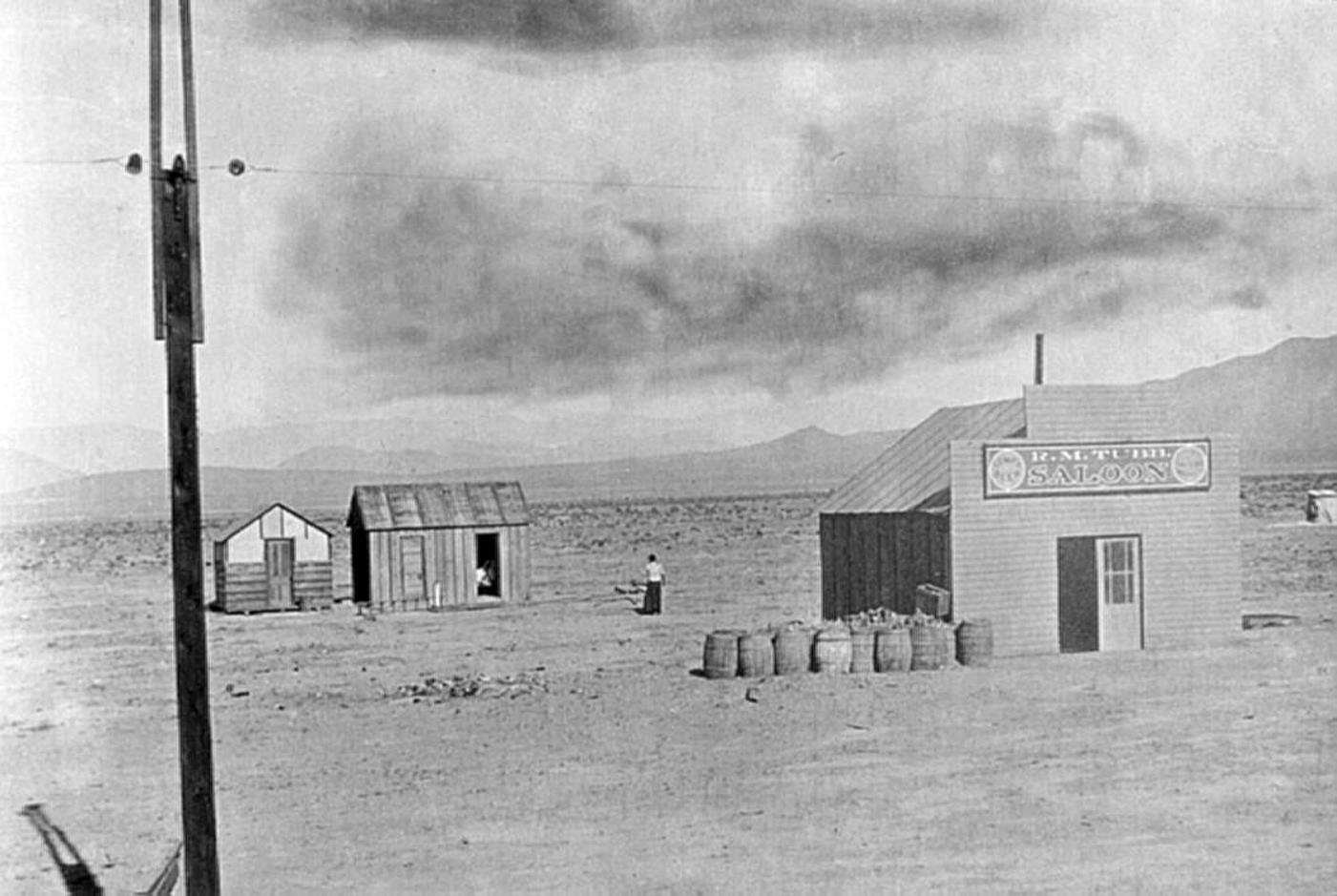
Before the railroad arrived at Death Valley Junction in 1907, Tubb and his wife set up a saloon and brothel at the location where the junction would soon be constructed. At first, the saloon was a tent on the east side of the tracks opposite the wye where the Lila C. branch split off. This photo shows a slightly more permanent structure in that location.
Tubb made a homestead claim for the land where the junction was located in 1907. Under the 1820 Homestead Act he had to live on the land for 5 years and "improve" it by farming something. He attempted to grow some crops and fruit trees on 320 acres of land, but that was ultimately unsuccessful. In 1912 he was granted a patent for ownership of the 160 acre quarter section where the town is located now.
Town beginnings
During the first few years, besides Tubb’s saloon, there was very little in Death Valley Junction. The 1910 census lists 20 residents, six of whom were members of the Tubb family. The rest of the residents mostly worked for the railroad. There was a foreman, several laborers, an engineer, a machinist, and three telegraph operators. The town of Ryan, where the Lila C. mine was located, had a much larger population of 85 residents.
In addition to the mine at Ryan, the borax company constructed a mill to concentrate the ore before shipment. William Smitheram was the mine superintendent and Fred Corkill was the mill superintendent. More than half of the 1910 population listed an occupation as "miner" or "mucker". A miner made $4.25 per day and a mucker made $3.25 per day. The mine and mill ran 24/7, 3 shifts per day. Most were American, but quite a few were immigrants from England or Sweden. No doubt the census was just a snapshot of a group that probably had a high rate of turnover. Many of them lived in a large company boarding house. They closed down during the hot summer months from June 1 to September 1.
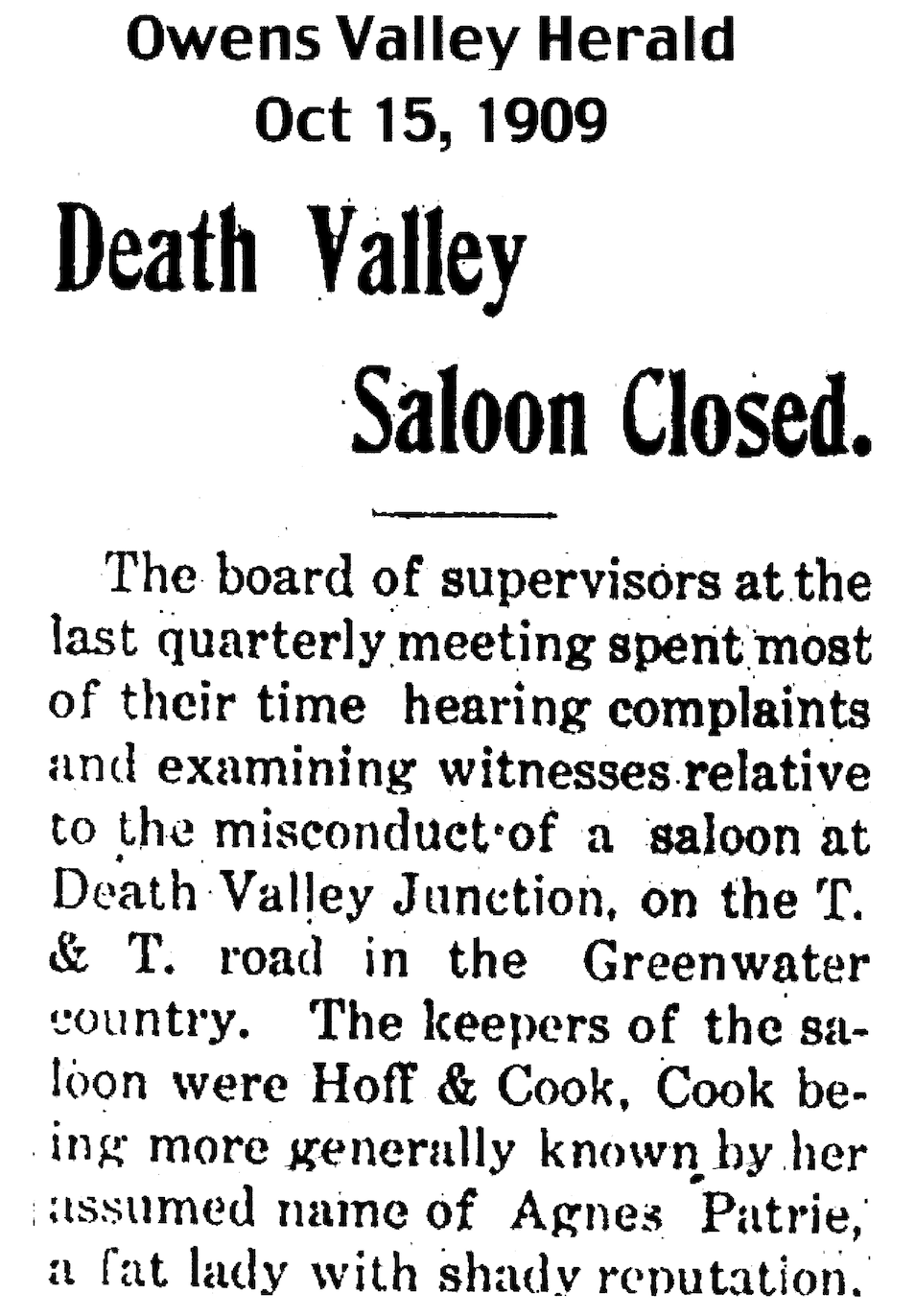
While the company provided food and shelter for the workers, there wasn't much in the way of entertainment in Ryan for single men. That's a need that Bob Tubb filled with his saloon and brothel. Tubb leased his saloon to two individuals named Nels Hoff and Hattie Cook in 1908. There were complaints which seemed to be centered around the fact that they served minors and women, and Hattie Cook was herself a woman(!). A hearing by the county Board of Supervisors in October 1909 revoked their liquor license on those grounds.
The Board after hearing the sworn testimony of the witnesses now finds; That said Hoff & Cook violated the provisions of Section 5 , subdivision 2 of Ordinance No. 97 and amendments thereto governing the sale of intoxicating liquor in this County, in this to-wit: selling liquor to minors under the age of 18 years, selling liquor to persons already under the influence thereof, and subdivision 5 thereof by allowing a woman and women to frequent the premises described in said permit and to loiter therein and thereon. And the Board further finds that said Hattie Cook one of the members of the firm Hoff & Cook is a woman, that she tends bar, shakes dice, drinks liquors and becomes intoxicated in said premises; that said Hattie Cook is not a fit, proper or suitable person to be engaged in the selling of intoxicating liquor in Inyo County, California; From the foregoing findings it is ordered and adjudged and this does order and adjuge [sic] that the permit and license to sell intoxicating liquors heretofore issued to said Hoff & Cook on the 7th day of July, 1909 be and the same is hereby revoked and the same declared null and void and of no further force or effect.
Nels Hoff was born in Norway in 1871 and emigrated to the US in 1895. Harriette “Hattie” Patrie was born in 1865 in Montreal Quebec and emigrated with her parents to Kansas before 1870. She married John Cook in Kansas in 1884, had 3 children, and divorced him in 1901. After getting kicked out of the saloon business, Hoff and Cook left town and eventually wound up in Los Angeles. They got married in 1915, and then divorced in 1918 after she caught him in bed with another woman. In 1920 Cook died and Nils Hoff was back in DVJ, listed the proprietor of a billiard parlor in the 1920 census. He eventually moved to somewhere in Kern County where he died in 1939. When Hattie died she has an estate worth $10,000. Her will specified that half was to go to Hoff and the rest to her 3 children. The children contested the will, but it is not known how that that was resolved.
Tubb continued to operate his saloon. Liquor licenses issued by Inyo county from 1912 to 1916 sometimes are in his name and sometimes in the names of others. In 1914 the California Red Light Abatement Act became law which shut down houses of prostitution, but enforcement may not have all that thorough. In 1916 Inyo County voted to go dry and ban the sale of alcohol, so Tubb had to shut down his saloon.
Tubb's property
Tubb didn't have use of all his land. When the railroad was built, it was on public land, and the company was given a right of way along the route, which extended for 100 feet on each side of the track. It appears that the Tubbs initially occupied land east of the right of way. In addition to the right of way along the tracks, a railroad company could acquire an adjoining 20 acres every 10 miles to accommodate infrastructure for the railroad such as depots and maintenance facilities which was known as the "station grounds". The T&T railroad selected a strip 440 feet wide by 1980 feet long adjacent to the east side of the right of way opposite the wye which meant that the Tubbs had to move from his first location on the east side of the tracks. A "right of way" is basically an easement and doesn't constitute ownership of the property. Tubb didn't control the use of a significant portion of his homestead, but the railroad had no say in what he could do on the rest of his property. This would become an ongoing issue.
The General Railroad Right-of-Way Act of 1875 states:
The right of way through the public lands of the United States is granted to any railroad company duly organized under the laws of any State or Territory, except the District of Columbia, or by the Congress of the United States, which shall have filed with the Secretary of the Interior a copy of its articles of incorporation, and due proofs of its organization under the same, to the extent of one hundred feet on each side of the central line of said road; also the right to take, from the public lands adjacent to the line of said road, material, earth, stone, and timber necessary for the construction of said railroad; also ground adjacent to such right of way for station buildings, depots, machine stops, side tracks, turnouts, and water stations, not to exceed in amount twenty acres for each station, to the extent of one station for each ten miles of its road.
Upon being granted ownership of his homestead, Tubb immediately took out a mortgage for approximately $2000.
In 1914 the Tubbs divorced. They had another homestead at Ash Meadows where they had been living that was granted in Kittie's name that year. In the divorce settlement, the Ash Meadows property was split evenly and Bob kept the Death Valley Junction property.
Bob Tubb remarried later in 1914 to a woman named Ella Bishop.
The early town
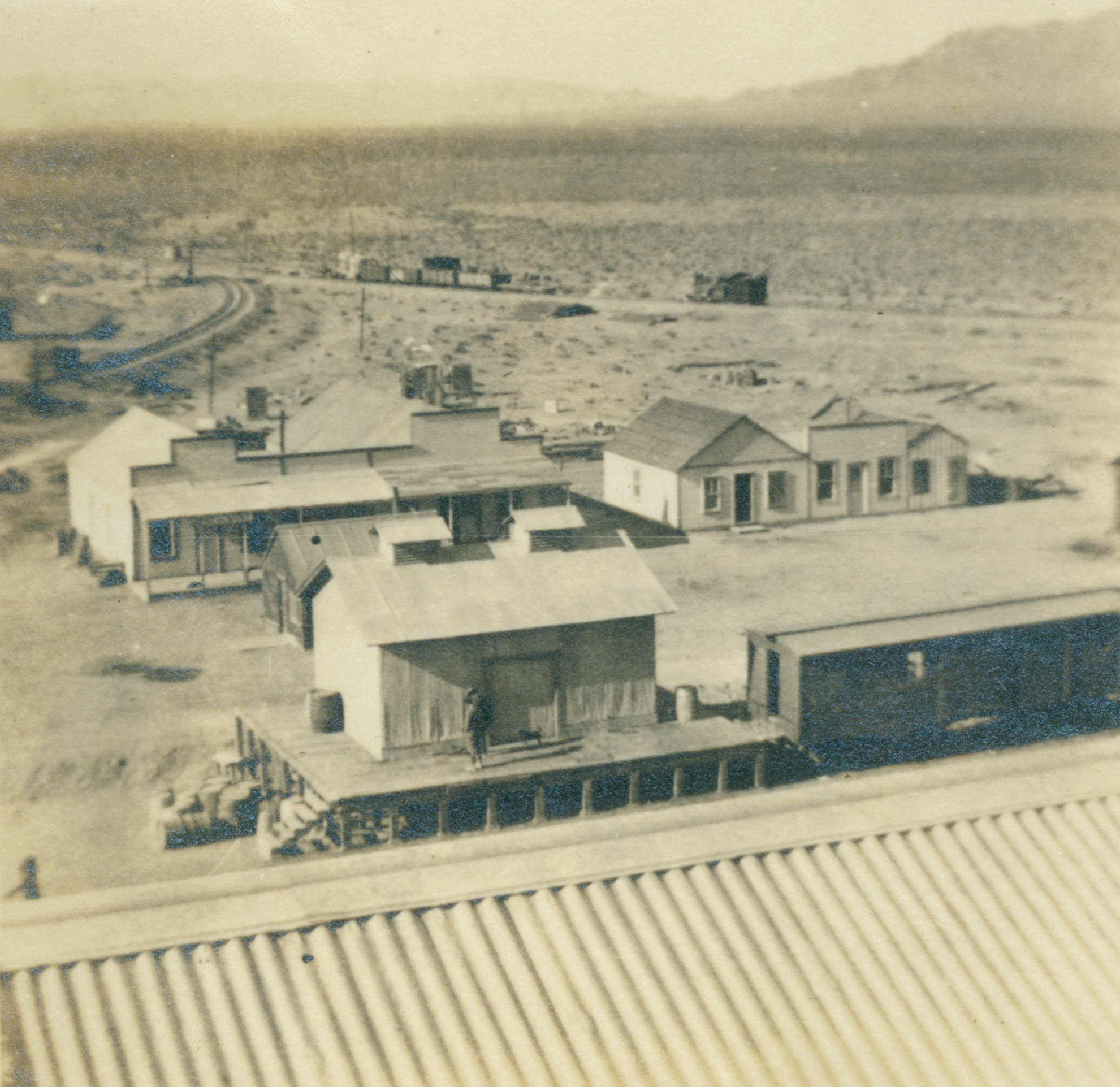
Before 1915, all the town buildings were located within the wye of the railroad. This may have been due, in part, because the railroad embankments would have provided protection against periodic flooding. There is no record of significant flooding during that time, but given the frequency that it occurs, it's probable that it happened.
The railroad had a depot, a small freight warehouse, a water tank, the section foreman's house, and another building that housed the section laborers. These were along the west side of the tracks in the right of way. West of those, in the triangular piece of land that didn't fall within the railroad right of way, was Tubb's saloon, and general store.
The new mines
In 1913, the Lila C. mine was beginning to run out. PCB had several claims 20 miles away on the other side of the Greenwater mountains above Death Valley. To access these mines, a railroad needed to be built. The owners of the borax company were reluctant to invest in more railroad, so F. M. Smith formed the Death Valley Railroad Company to build it. Because of the terrain, this railroad was going to have to be 3 ft. narrow gauge as opposed to the 4 ft. 8.5 in. standard gauge of the T&T.
The DVRR was built in 1914, starting at a point on the existing spur midway between DVJ and Ryan, which was named Horton Junction. Borax ore had been processed at the mill in Ryan, but it was decided that the mill should be moved to Death Valley Junction and expanded. This was completed in 1915 and the town was transformed.
Next: Borax 1915-1928