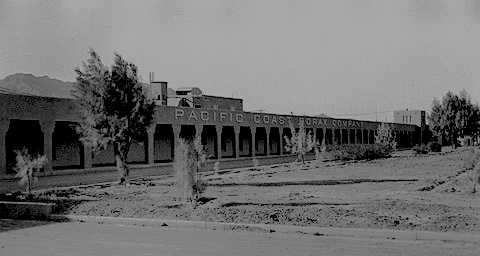
Death Valley Junction History Project
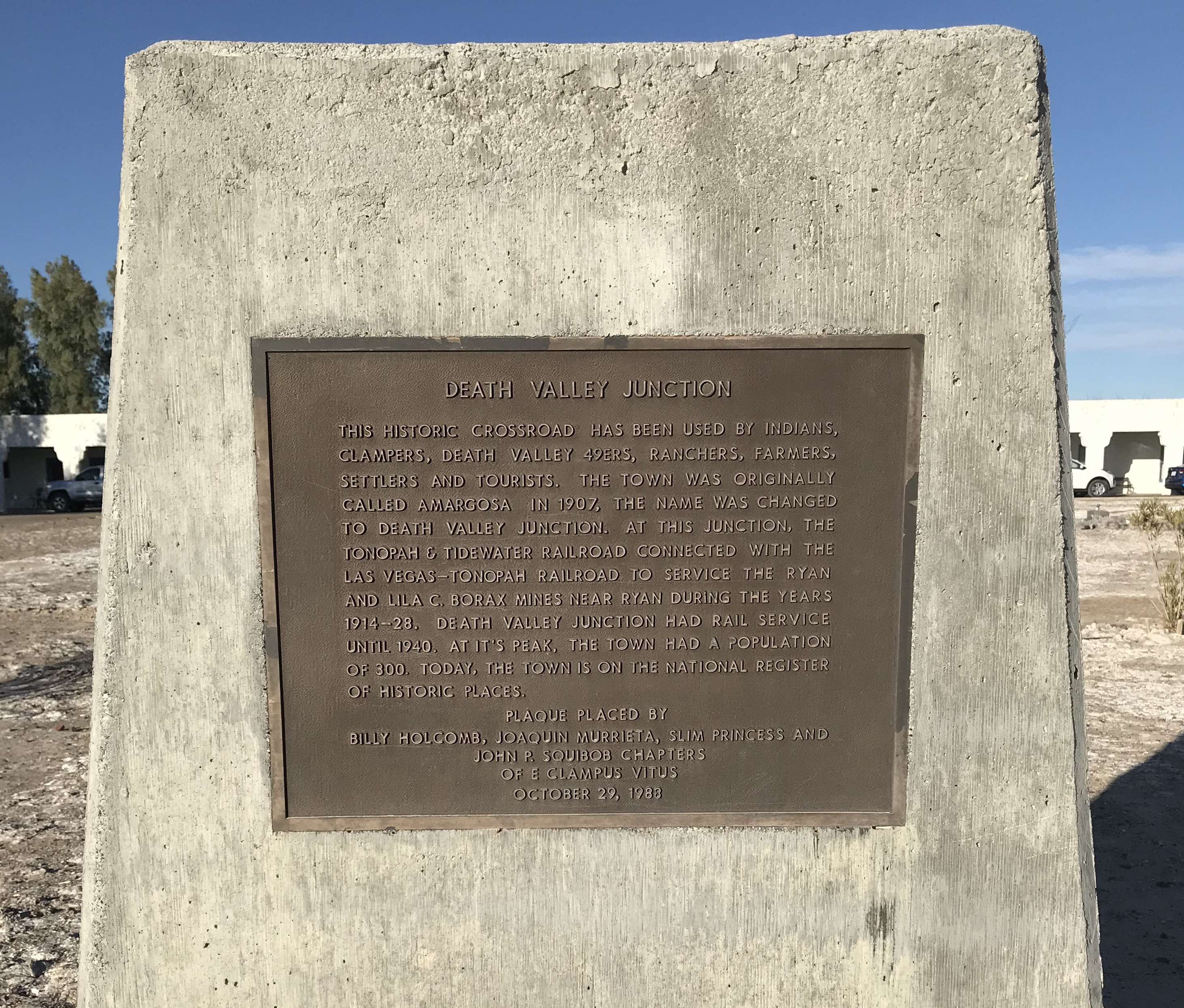
There is a marker on the road in front of the town square in Death Valley Junction that reads
“This historic crossroad has been used by Indians, Clampers, Death Valley 49ers, ranchers, farmers, settlers and tourists. The town was originally called Amargosa. In 1907, the name was changed to Death Valley Junction. At this junction, the Tonopah & Tidewater Railroad connected with the Las Vegas-Tonopah Railroad to service the Ryan and Lila C. borax mines near Ryan during the years 1914-28. Death Valley Junction had rail service until 1940. At it's [sic] peak, the town had a population of 300. Today, the town is on the National Register of Historic Places.”
The marker was placed in 1988 by a group called E. Clampus Vitus. The fact that this group is self-described “historical drinking society” whose motto is Credo Quia Absurdum, which is the somewhat butchered latin phrase meaning "I believe it because it is absurd”, means that one should probably do some fact checking on what is inscribed on their marker. Aside from the spelling error, there are two glaring factual errors. First, there’s no evidence the town was ever called Amargosa or that there was ever anything resembling a town or even a crossroads at that location before 1907 when the Tonopah & Tidewater railroad built a junction on that spot. Second, the junction wasn't with the Las Vegas-Tonopah Railroad, it was with a spur line that went to the borax mines. The T&T never connected with the LV&T. Finally, although not technically wrong, the phrase "Ryan and Lila C. borax mines near Ryan" is confusing. Cheers!
Death Valley Junction exists where it does due to a combination of factors related to geology, economics, and a series of choices, that easily could not have happened.
Before 1906, Death Valley Junction wasn’t a “place”. There is no record of any settlement, crossroads, or even any road that went directly through that particular location. There is no interesting geologic feature to draw people to it. It’s not on the shore of a lake or a river. There is no natural spring there. It’s just a spot in the middle of the Amargosa Desert where a mining company decided to connect a railroad spur to the main line, and it was probably chosen mainly due to considerations of engineering and economics. Before that happened there had been human activity around the area for thousands of years, but nothing that has been noted right in that spot.
The earliest human inhabitants of the region arrived around 7000 BCE. The more recent inhabitants of the region, the Paiute and Shoshone, probably arrived around 900 CE. The nearest archaeological sites that show any evidence of human habitation are at Franklin Well and Ash Meadows. There may have been some early Spanish or Mexican explorers transiting the area, but there is no definitive record of them coming near there. The 1831 Antonio Armijo expedition passed through Tecopa, 50 miles away.
The first accounts of Americans to come through the Amargosa Valley were the groups trying to get to the California gold fields in 1849. Rather than take the more established route from Salt Lake City to Los Angeles and then north to where the gold was, some of them foolishly thought they could take an unverified shortcut across the desert. At least one group came through Ash Meadows, camped on the Amargosa river near the Funeral Mountains several miles north of Death Valley Junction, and then proceeded around the Funeral Mountains into Death Valley via Furnace Creek Wash, passing within a mile or so of the present site of Death Valley Junction. There is an indication that there was a skirmish between them and some Paiutes near there, after the Americans had helped themselves to the Paiutes' crops and then refused to compensate them.
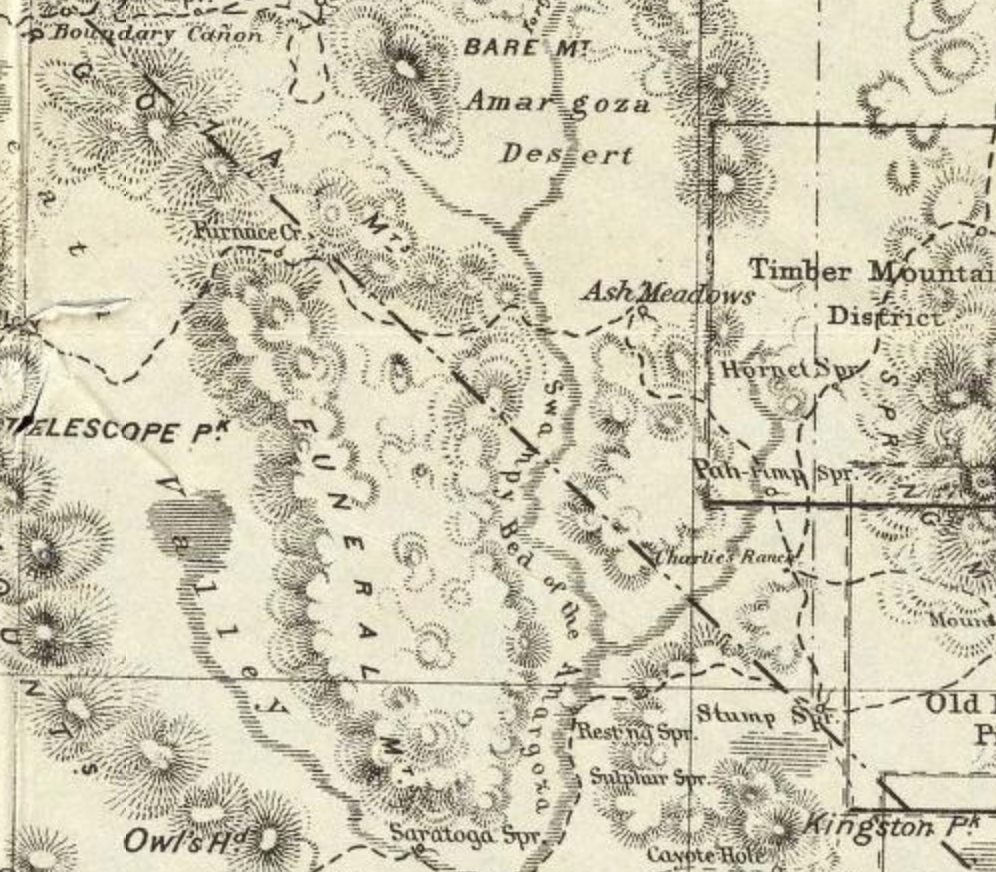
The route of the 1849 expedition through the Amargosa Valley became an established route with a number of wells and at least one roadhouse. Franklin’s well was dug in 1852 at the site of the 1849 expedition campsite and at least two other wells, Kelley’s and Nelson’s, were established on the trail along the southeastern flank of the Funeral mountains. Members of the 1871 Wheeler and Lyle Survey and the 1891 Death Valley Expedition used this route. In the early 1900s it was part of the route from Ash Meadows to the short lived copper mining town of Greenwater.
Demand for borax was the driving factor that brought about the creation of Death Valley Junction. The Death Valley region has many minerals, but even though many people found amounts of gold, silver, copper, and other such valuable metals, the projects usually failed. The area is very remote and arid, so the value of what was produced was never enough to justify the costs of maintaining a mining operation, processing the ore, and transporting the product. From the late 1800s to the early 1900s, practically no one except swindlers and con men made any money there. Borax is the only commodity that was able to actually be economically feasible, at least for a while.
Why is the borax there? “Borax” is the name commonly applied to a compound of the element boron. Boron is relatively rare on earth, comprising only 0.00086% of the earth’s crust, but it is essential to the growth of many plants and has many human uses. Boron occurs in the oldest rocks on earth and is found in seawater, but only a few places have significant concentrations of its compounds. The borax in the Death Valley area is found in the Furnace Creek formation, which is a layer of cemented gravel and silt deposited in an ancient lake (Furnace Creek Lake) that contains a lot of salts, especially borates. This occurred around 5 million years ago. The borates were concentrated from hot spring waters from nearby volcanic fields. Later, the sediments were uplifted and faulted to create the Black Mountains. Outcrops of this formation occur at the mouth of Furnace Creek Canyon and at various places to the southeast. Borax is also present in the deposits on the floor of Death Valley north of Furnace Creek due to erosion of this formation. In addition to the Death Valley area, borax deposits are also located at Borate and Kramer in the Mojave to the southwest. The order in which these deposits were discovered, mined, and played out is important to this story.
In 1881, the deposits on the floor of Death Valley were discovered and immediately bought by William Coleman who began an operation called Harmony Borax Works the next year to collect it and ship it using the famous 20 mule team wagons to the nearest railroad siding in Mojave, 165 miles away. A year later, mining claims were staked in the Black Mountains at Monte Blanco, and a year later another one 15 miles to the southeast, all of which Coleman purchased. This last claim was named "Lila C."", after Coleman’s daughter and is key to why Death Valley Junction is where it is. Meanwhile, Francis Smith, who had found some borax in Nevada at Teel’s Marsh in the 1860s, was also producing borax from deposits found in 1883 at Borate, near the Calico silver mine.
Mining of a valuable commodity is easy, at least on paper. You stake a claim and then just dig it up. The hard part is getting it to market and still making a profit. Death Valley was very promising for finding minerals, but in the late 1800s and early 1900s it was relatively inaccessible. Coleman had made money scraping up borax from the floor of Death Valley, concentrating it with a process that didn’t require a lot of fuel and hauling it to the nearest railroad in wagons. But the borax sitting on the ground at Harmony eventually ran out, and because Coleman had over extended himself in buying up all the nearby borax claims, he eventually went bankrupt in 1890. Smith bought Coleman’s claims but didn’t do anything with them initially because he was mining borax in Borate which was much closer to the railroad.
In 1903 the production of Borate was beginning to decline, so Smith, anticipating its imminent exhaustion, began developing the next nearest deposit that he owned, which was Lila C. This was over 140 miles north of Borate and 100 miles from the nearest rail line at the time. He had to establish a more economical transportation mechanism than mule teams to get it to market. Smith’s first plan was to build a railroad, but his thrifty British investors didn’t want to spend the money. He eventually negotiated to build a “traction road”, which was basically a graded dirt road, to the nearest rail line in Ivanpah and use a newfangled gasoline-electric tractor to haul the borax that was being developed by the New York company.
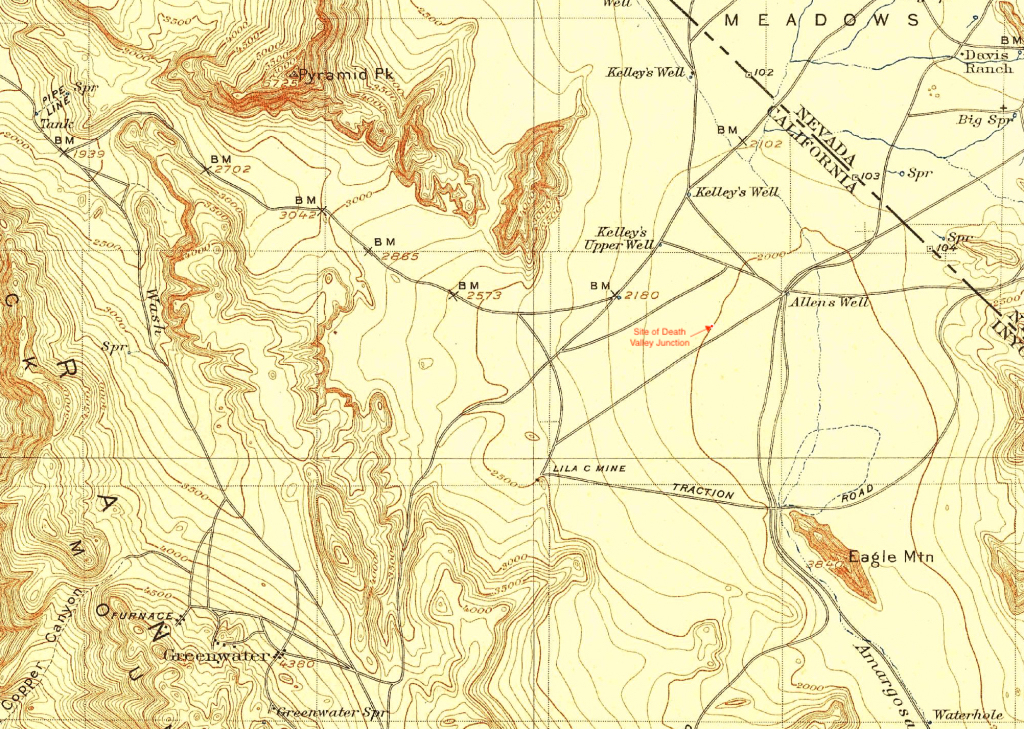
In June 1903 the construction of the traction road began from Ivanpah, through Stateline pass, the Mesquite and Pahrump valleys, and across the Amargosa valley north of Eagle Mountain the the Lila C., and was completed in less than a year in April 1904. He had his road, but the state of the art tractor was still on the drawing board, so Smith resurrected Old Dinah.
Old Dinah is a caricature of 19th century technology. It was a massive contraption of steel, fueled by coal, belching smoke and farting steam. It was unreliable and required constant maintenance. Burning 250 pounds of coal per hour and cruising at 3.5 miles per hour, she would have required almost 4 tons of coal to make it one way to the Lila C. from the railroad. But she never made it even once. On the first test run, she couldn’t make it up the first grade to the pass, broke down, and had to be towed back by a mule team. The carcass of this machine is now on display in Furnace Creek.
Smith apparently never believed that the traction road solution would work and that the road he had built could be converted to a railroad, which was what he wanted to do in the first place. But it turned out that the curves and grades that had overcome Old Dinah could not be economically made into a railroad grade, so the traction road had to be abandoned. Had the traction road been a success, borax would have been hauled east from the Lila C. past the north side of Eagle Mountain and the Resting Springs Range, and down the Pahrump and Mesquite valleys. There would have been no Death Valley Junction in its present location.
Smith’s next attempt to build a railroad to his mine involved a lengthy negotiation with William Clark who was invested in the gold mines in Bullfrog and Tonopah. Clark was building a railroad from Los Angeles to Salt Lake City and had surveyed a line from Las Vegas to Tonopah. They reached a deal where Smith would construct the line and would be able to build a branch from it to the Lila C. This would have to the north of the mine and the station on the LV&T railroad called "Amargosa". (Perhaps this is the origin of the misinformation on the marker) Smith’s crew began the work, but they had only graded a few miles of roadbed from Las Vegas when Clark abruptly pulled out of the deal. Again, had this plan worked out, there would have been a line from the Lila C. north through Ash Meadows and no reason for Death Valley Junction.
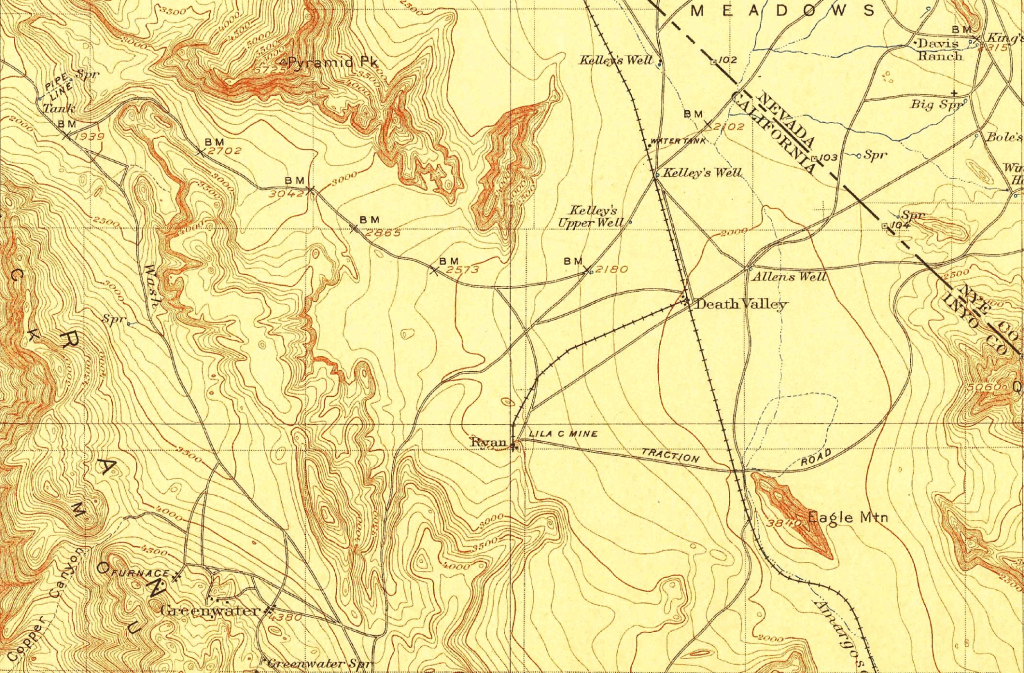
This led to Smith’s next plan, which was finally built. His railroad would start at Ludlow where it would connect to the Santa Fe line and head north through Amargosa Canyon to Ash Meadows. Because Smith still had his eye on the gold fields to the north, the main line of the T&T was surveyed in a straight line from Eagle Mountain to the Funeral Range where it began a gradual curve to the left along the Amargosa River. The spur to the Lila C. ran north from the mine, gradually curving to the right, and then in a straight line to intersect the main line at almost a right angle at a point in the desert. Thus Death Valley Junction was created in 1905 or 1906 when the route was surveyed. Evidently this was determined with the considerations of efficient railroad engineering and minimal construction costs in mind.
Next: Early days 1907-1914